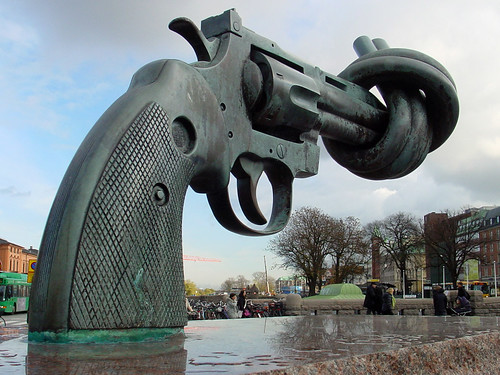
This article’s title comes from a Simpson’s chapter, but it's applicable –and oh so well- to basically any subject in which the Big Brother appears. The State, that fictional character that we, the society, needed to create in order to protect us from ourselves, from the social chaos and the anarchy, seems to be having a lot of preponderancy over the citizen’s rights these days.
Last couple of weeks, Wikileaks’ case, and specially, Julian Assange’s bizarre persecution for a felony involving the misuse of a condom (which now, apparently, is called violation in some countries), have taken over all social networks and media.
What is really interesting is that this entire story already happened. A lot of us aren’t old enough to remember –I wasn’t even born-, but in 1971, Daniel Ellsberg gave to The New York Times a group of documents, and they, after verifying their accuracy and authenticity, started publishing them. The USA government filed a petition against them: those documents contained secrets of State, and they asked the Supreme Court to stop and forbid the publication of those documents. But the Supreme Court decided that foreseen censorship was against constitutional rights. The judge couldn’t assure that the revelation of the Pentagon Papers was going to cause a direct, immediate damage to the country or its citizens, and therefore, the government couldn’t stop The NY Times from making public those documents.
However, as Lawrence Lessig affirms, the need for constitutional protection of secrets of State would disappear as soon as those secrets are revealed. Information that has been leaked cannot be hidden anymore: moreover, Internet will exhaustively replicate any information that has become of interest, even if only for the mere curiosity that censorship itself can lift.
What is really worrying governments all over the world is Wikileaks’ credibility. Not even one of those governments involved has denied the veracity of those documents, and the reason is the one that should really be worrying them: Wikileaks has way more credibility than any of them, and it is not only that governments have lost almost all trustworthiness before their citizens, but also that Internet seems to be now just as reliable, if not more, as any traditional media.
Some people is comparing this revelation of secrets of State, with the possible revelation of a person’s private life, trying to make assumptions over its illegitimacy. Quite the opposite, individual rights are not alike the rights of a State for its own preservation, because its mere existence only should depend on its capacity of fulfilling its people’s rights and aspirations. But it doesn’t: actually, the preservation of a State depends on its capacity of keeping information repressed, and it doesn’t have anything to do with the interests of its nationals.
In this same regard, I've heard some people saying that the Internet, as every possible human behavior, is in the need for legal regulation. However, I dissent: Internet already regulated itself, and legislators are late for the party. Netizens, after decades of online activity, have already come to agreement concerning which behavior is acceptable and which is unacceptable, and trying to impose civil laws to the web would be as useless as trying to impose occidental institutions in an ancient tribal society. An indigenous group, for instance, is not unregulated but self-regulated, and so is the Internet, and the misinterpretation between these two ideas is only in the eye of the beholder.
However, discussion seems to be taking a different direction; it is not about the content of what has been “leaked”, but about the alleged violation of secrets of State, that apparently, in the American way of doing things, is above any civil right, not only those concerning freedom of press, speech and information, but also upon human rights and other States’ sovereignty. Apparently, the way of elude responsibility on any event, even if it’s illegal, is declare it Secret of State, of course, if one has the option of doing so.
What we seem to be forgetting is that governments only exist because we, as a collective, transfer (trough the vote) our sovereignty to a higher and fictional entity, which is supposed to answer before us when we hold them accountable. However, in a world where most traditional media is sold to the system, our “right to know” seems to be dissolved, appearing less and less important while they try to convince us that our Father State is going to take our decisions, for us, better than us. They say they don’t have anything to hide, but still they want to rule us without telling us how or why.
A new model of consumption of information, a new paradigm of expression and exchange, this is what is driving governments crazy in all places. Internet, and not internet itself but its users, citizens everywhere, have come to break the pact of silence. Old school politicians who belong in paralyzed structures of power don’t understand the web. They still don’t get how information flows, they have no idea of how to contain the public opinion, and this is just freaking them out. Therefore, what we can’t forget is that the very thing we are trying to preserve is the use of the Internet as a tool for free speech, as a real tool for democratization of media, for public access of information and for government’s accountability all over the world.
Showing posts with label Human Rights. Show all posts
Monday, December 13, 2010
On how to foster unrest in a whole country through only one tweet
It seems like a very ambitious goal, but apparently, it is dreadfully possible indeed. The venezuelan government, for what one can assume from its recent policies regarding the use of internet, believes that a single twitter user, with a hundred followers or less, can destabilize an entire political system.
In the last year, citizens have been detained for tweeting about the banking system, for going around saying they want to see the president dead, and for taking pictures of the deterioration of the capitol’s subway system. Their very brief detentions haven’t reached international media, and in appearance, have had only the intention to weaken public opinion and promote self-censorship. In the meantime, Venezuelan President, Hugo Chávez, opened a twitter account and promoted an image of openness and accessibility, a very incongruous one in fact.
However, last week things seem to have gotten darker: The Venezuelan vice-president has filed before the National Assembly a bill that proposes a wide reform, under which an administrative organ, Conatel, would have competences over the Internet. Conatel, dependent to the Ministry of Communications, is a bureau created in order to regulate all content transmitted in national television and radio. Among all rumors flying over the net and traditional media this last days, it has been said that the law would make extensive the so-called “time slots” to the Internet, regulating which content is accessible according to the new regulations regarding matter of language, sex and violence.
As if that’s not enough, the law contemplates the creation of a national Network Access Point, being controlled by Cantv, the government owned ISP. Cantv has a long story as an untrustworthy service provider, being blamed for diverse website blockages through the last years; the most recent one, a Wordpress “blackout” that lasted two days, coinciding with the elections performed last September 26th.
If we compare the actual influence of a twitter user like @leaoxford, who was detained last July because of a tweet that “caused destabilization of the national banking system” –and is now under probation-, a very simple procedure that can be done using Twinfluence or something similar, we can easily establish that in real world, Leo Acosta Oxford could have mobilized, in best case scenario, a manifestation of 50 people or so. Or, what is the same, none of us even knew who @leaoxford was before he was imprisoned. A person, in order to cause public distress through a web service like twitter, would need to have a lot of personal influence (which means, to be someone like @NelsonBocaranda or @AlbertoRavell), and even in that case, s/he might as well use any other way of communication, like newspapers or television: it’s not about the media, but about the message and the person, and still, the government wants to avoid that ordinary people goes around saying stuff online. And this is the government that, allegedly, wanted to give a voice to people who hadn’t been heard before. This, people, is what Internet does: that every person –with internet access, and that’s a horse of a different color- can speak out their mind, not only those with certain privileges, social position or political affiliation.
As I’ve said before, power is not frightened by people but ideas. I can only wonder how unstable is actually a government that gives that kind of importance to 140 characters or less.
In the last year, citizens have been detained for tweeting about the banking system, for going around saying they want to see the president dead, and for taking pictures of the deterioration of the capitol’s subway system. Their very brief detentions haven’t reached international media, and in appearance, have had only the intention to weaken public opinion and promote self-censorship. In the meantime, Venezuelan President, Hugo Chávez, opened a twitter account and promoted an image of openness and accessibility, a very incongruous one in fact.
However, last week things seem to have gotten darker: The Venezuelan vice-president has filed before the National Assembly a bill that proposes a wide reform, under which an administrative organ, Conatel, would have competences over the Internet. Conatel, dependent to the Ministry of Communications, is a bureau created in order to regulate all content transmitted in national television and radio. Among all rumors flying over the net and traditional media this last days, it has been said that the law would make extensive the so-called “time slots” to the Internet, regulating which content is accessible according to the new regulations regarding matter of language, sex and violence.
As if that’s not enough, the law contemplates the creation of a national Network Access Point, being controlled by Cantv, the government owned ISP. Cantv has a long story as an untrustworthy service provider, being blamed for diverse website blockages through the last years; the most recent one, a Wordpress “blackout” that lasted two days, coinciding with the elections performed last September 26th.
If we compare the actual influence of a twitter user like @leaoxford, who was detained last July because of a tweet that “caused destabilization of the national banking system” –and is now under probation-, a very simple procedure that can be done using Twinfluence or something similar, we can easily establish that in real world, Leo Acosta Oxford could have mobilized, in best case scenario, a manifestation of 50 people or so. Or, what is the same, none of us even knew who @leaoxford was before he was imprisoned. A person, in order to cause public distress through a web service like twitter, would need to have a lot of personal influence (which means, to be someone like @NelsonBocaranda or @AlbertoRavell), and even in that case, s/he might as well use any other way of communication, like newspapers or television: it’s not about the media, but about the message and the person, and still, the government wants to avoid that ordinary people goes around saying stuff online. And this is the government that, allegedly, wanted to give a voice to people who hadn’t been heard before. This, people, is what Internet does: that every person –with internet access, and that’s a horse of a different color- can speak out their mind, not only those with certain privileges, social position or political affiliation.
As I’ve said before, power is not frightened by people but ideas. I can only wonder how unstable is actually a government that gives that kind of importance to 140 characters or less.
Labels:
English,
Freedom of Speech,
Human Rights,
Venezuela
Friday, April 30, 2010
“Where do you want me to shoot you?” : Interpersonal violence is a matter of health
This article was originally written for Th!nk about it: Developing world.
- Francisco was driving from work that night, at 7:00 p.m., and he was waiting for the red light to turn green, when a man pointed at him with a weapon from outside the window. Francisco got off the car and handed him the keys, and the man took the car and leaved. Ten seconds later, he came back, in reverse, and he told Francisco: "You almost left with nothing. Where do you want me to shoot you?".
Monday, April 26, 2010
Venezuela has achieved environmental sustainability: True or false?
This post was originally written for Th!nk About It: Developing World.
Labels:
Environment,
Human Rights,
Indigenous Peoples,
MDG,
Venezuela,
Water
Wednesday, April 21, 2010
No one goes hungry in Venezuela: True or false?
Last march, President Chávez stated that "No one goes hungry in Venezuela", an affirmation that he might as well have taken from the official report "Venezuela accomplished the MDGs": Government states that extreme poverty has reduced from 17,1% in 1998, to 7,9% in 2007.
Labels:
Human Rights,
Hunger,
MDG,
Poverty,
Venezuela
Tap water doesn't mean drinking water: Interview with the Movement for Water Quality
(This article was originally written for Th!nk about it: Developing world)
Venezuelan government states that 92% of the population has access to drinking water. Meanwhile, the consequences of a long drought strike Venezuela and the inhabitants of Valencia are affected by polluted water coming from their taps.
Labels:
English,
Environment,
Health,
Human Rights,
MDG,
Venezuela,
Water
Friday, April 16, 2010
President Chávez and his "communicational guerrilla"
This post was written for Global Voices Advocacy.On last sunday, Venezuelan President Hugo Chávez launched the program named “Communicational Thunder”, in order to "face the lies and misinformation spread by private media". "Media battle has to be fought everyday", he said. That day, in his weekly sunday TV program, seventy-five young students between ages 13 and 17, were sworn in his "Communicational Guerrilla", wearing khaki jackets and red bandanas tied around their necks. They had been trained to "fight against imperialist messages", either on social networks online, on walls and pamphlets or "through direct intervention".
Labels:
English,
Freedom of Speech,
Human Rights,
Venezuela
Monday, April 12, 2010
Oil, coal, development and indigenous people: In the search for a peaceful settlement
According to UNICEF, the Guajira ranks second among the poorest places in Latin America after Haiti. Wayuus, who represent around 54% of all indigenous population of Venezuela, doesn't have stable access to potable water, suffer of an overly high rate of children mortality (two to three children die everyday of malnutrition), and lack of well-supplied schools, health facilities and hospitals.
Labels:
English,
Human Rights,
Indigenous Peoples,
MDG,
Poverty,
Venezuela
Subscribe to:
Posts (Atom)